Hands-On Lab Experience and Research Opportunities in the Heart of Boston

Chemistry majors at Emmanuel investigate how atoms combine, react, and release energy; knowledge that powers breakthroughs in medicine, sustainable materials, and clean technology. Through a curriculum that spans analytical, organic, physical, and biochemistry, you’ll master the principles that drive everything from pharmaceutical design to climate solutions.

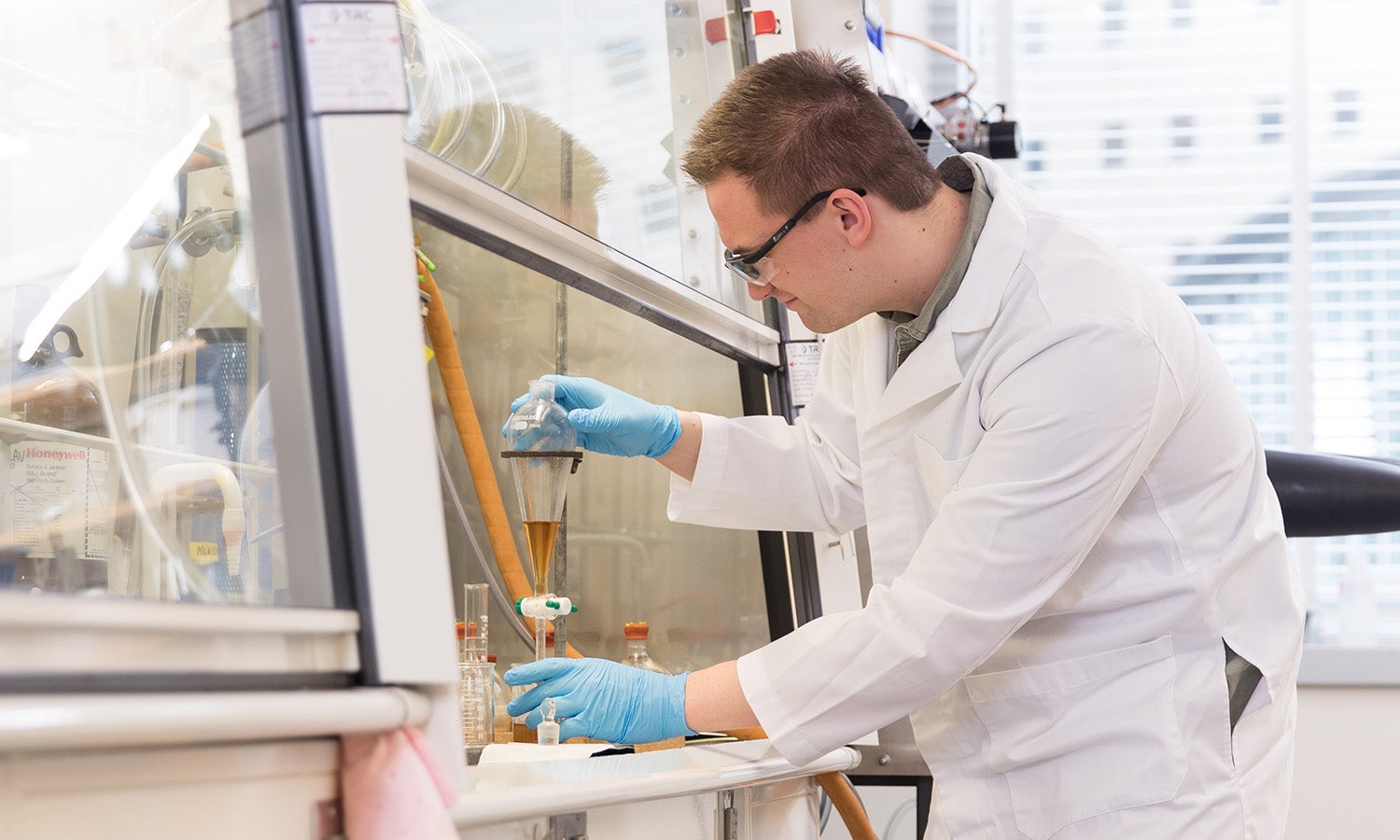
In the Wilkens Science Center, you’ll work closely with faculty mentors and gain experience using professional-grade instrumentation. Whether in class or through collaborative research, you’ll apply scientific methods to investigate real questions and build confidence in a laboratory setting.

Located in Boston—a city known for innovation in science, healthcare, and education—Emmanuel connects you with opportunities for internships, graduate study and careers in pharmaceuticals, environmental science and beyond.

Outcomes & Outlook

100%

of Class of 2024 chemistry graduates were employed by one year after graduation
Emmanuel College Outcomes Survey, 2025

100%

of Class of 2025 chemistry graduates report their major prepared them for a career after graduation
Exit Survey, Class of 2025

#3

city in the country for jobs in chemistry (Boston)
Bureau of Labor Statistics, 2025

$129K

annual mean wage for chemistry professionials (Boston)
Bureau of Labor Statistics, 2025

A First-Class Experience

Get to know the people and programs that will define your academic journey.

DNA, Designed: Georgia Kazis ’27 Builds Toward Publication

Chemistry major Georgia Kazis ’27 is building 3D DNA structures that mimic the biomaterials found in bones and teeth—part of a long-term research project with Professor Aren Gerdon exploring the science behind conditions like osteoporosis and kidney stones.

Meet the Faculty

Our distinguished faculty publish, exhibit and research. Present, compose and chair. Inspire and collaborate.

The Curriculum

View the 2024-2025 Academic Catalog to find course titles, numbers and descriptions.

Requirements for B.S. in Chemistry

  • CHEM1101 Principles of Chemistry I (SI-L) (NSL) 
  • CHEM1102 Principles of Chemistry II (SI-L) (NSL)
  • CHEM2101 Organic Chemistry I
  • CHEM2102 Organic Chemistry II
  • CHEM2104 Analytical Chemistry
  • CHEM3105 Physical Chemistry I: Thermodynamics
  • CHEM3106 Physical Chemistry II: Quantum Mechanics
  • CHEM3160 Social Justice ChemistrySeminar (SJ) (WI)
  • CHEM4194 Internship in Chemistry
  • MATH1111 Calculus I (QA) (QR)
  • MATH1112 Calculus II (QA) (QR)
  • PHYS2201 General Physics I (Calculus based)(SI-L)
  • PHYS2202 General Physics II (Calculus based)(SI-L) (NSL)
  • Three electives selected from upper-level chemistry courses, except INT3211, CHEM4178, CHEM4194-4195

View the 2024-2025 Academic Catalog to find course titles, numbers and descriptions.

Requirements for B.S. in Chemistry - ACS

  • CHEM1101 Principles of Chemistry I (SI-L) (NSL) 
  • CHEM1102 Principles of Chemistry II (SI-L) (NSL) 
  • BIOL1105 Introduction to Cellular and Molecular Biology (SI-L) (NSL) 
  • CHEM2101 Organic Chemistry I
  • CHEM2102 Organic Chemistry II
  • CHEM2104 Analytical Chemistry
  • CHEM2211 Biochemistry
  • CHEM2115 Inorganic Chemistry
  • CHEM3105 Physical Chemistry I: Thermodynamics
  • CHEM3106 Physical Chemistry II: Quantum Mechanics
  • CHEM3160 Social Justice Chemistry Seminar (SJ) (WI)
  • CHEM4194 Internship in Chemistry
  • MATH1111 Calculus I (QA) (QR)
  • MATH1112 Calculus II (QA) (QR)
  • PHYS2201 General Physics I (Calculus based)(SI-L)
  • PHYS2202 General Physics II (Calculus based)(SI-L) (NSL)
  • Two electives selected from upper-level chemistry courses, except INT3211, CHEM4178, CHEM4194-4195

View the 2024-2025 Academic Catalog to find course titles, numbers and descriptions.

Requirements for Minor in Chemistry

  • CHEM1101 Principles of Chemistry I (SI-L) (NSL)
  • CHEM1102 Principles of Chemistry II (SI-L) (NSL) 
  • Four upper-level chemistry courses excluding CHEM4160, CHEM4194, CHEM4195 and INT3211.

At the completion of the Chemistry degree the student will be able to:

  • Apply knowledge of the sub-disciplines of chemistry including biochemistry, inorganic, organic, analytical, and physical chemistry.
  • Develop testable chemical hypotheses, design and execute experiments to test the hypotheses, analyze the data, and draw meaningful conclusions.
  • Effectively communicate chemical knowledge and research to general and specialized audiences.
  • Execute chemical literature searches to assess experimental design, results, and conclusions in scientific scholarly articles.
  • Utilize laboratory skills of experimental design, chemical synthesis, purification, data and error analysis, and computational analysis with full regard to safe laboratory practices.
  • Follow a high standard of ethics in regard to the scientific method.

Students seeking teacher licensure in chemistry must complete a major in chemistry, as well as complete required education courses and ­student teaching. Education requirements are available through the education department.  Interested students should also consult the chemistry department regarding the optimal selection of electives.

Students seeking Initial Licensure in Massachusetts must pass the Massachusetts Tests for Educator Licensure (MTEL).


Juan Alejandro ’25 Explores Science and Care

From the lab to primary care, Juan connects chemistry research with a passion for community health.

What can I do with a degree in chemistry?

A degree in chemistry offers a wide range of career opportunities across various industries, including healthcare, pharmaceuticals, education, environmental science, and more. Here are some potential jobs and career paths for chemistry majors:

Research and Development

  • Research Chemist: Conducts experiments and research to develop new products or enhance existing ones in fields like materials science, pharmaceuticals, or cosmetics.
  • Analytical Chemist: Analyzes substances to determine their composition and concentration, working in labs, environmental agencies, or quality control.

Healthcare and Pharmaceuticals

  • Pharmaceutical Chemist: Works on developing and testing new drugs, ensuring they are safe and effective.
  • Clinical Chemist: Analyzes bodily fluids and tissues to diagnose and monitor diseases, often working in hospitals or clinical laboratories.
  • Toxicologist: Studies the effects of chemicals on living organisms and the environment, often working in pharmaceuticals, environmental health, or regulatory agencies.

Environmental Science

  • Environmental Chemist: Studies the effects of chemicals on the environment, develops methods to reduce pollution, and ensures compliance with environmental regulations.
  • Water Quality Scientist: Monitors and assesses the quality of water sources, working for government agencies, environmental organizations, or private companies.

Education

  • High School Chemistry Teacher: Teaches chemistry at the high school level, usually requiring a teaching credential.
  • College or University Professor: Conducts research and teaches at the collegiate level, typically requiring a Ph.D.

Industrial Chemistry

  • Chemical Engineer: Applies principles of chemistry, physics, and engineering to design and operate processes for large-scale chemical manufacturing.
  • Materials Scientist: Develops new materials with specific properties for use in various applications, such as electronics, aerospace, or construction.

Quality Control and Assurance

  • Quality Control Chemist: Ensures products meet quality and safety standards by conducting tests and inspections, often in the pharmaceutical, food, or manufacturing industries.
  • Regulatory Affairs Specialist: Ensures that products comply with regulations and standards set by government agencies.

Forensic Science

  • Forensic Chemist: Analyzes evidence from crime scenes, such as drugs, blood, and other substances, to assist in criminal investigations.

Biotechnology

  • Biochemist: Studies the chemical processes within living organisms, often working in medical research, agricultural development, or industrial biotechnology.
  • Biotechnologist: Develops and uses biological processes for industrial and other purposes, such as developing new biofuels or agricultural products.

Cosmetics and Personal Care

  • Cosmetic Chemist: Develops and tests products such as makeup, skincare, and haircare items, ensuring they are safe and effective.

Agriculture and Food Science

  • Food Chemist: Studies the chemistry of food components, develops new food products, and ensures food safety and quality.
  • Agricultural Chemist: Works on improving crop yields, developing fertilizers, pesticides, and other agricultural chemicals.

Intellectual Property and Patent Law

  • Patent Examiner/Agent: Reviews patent applications and ensures they meet the necessary criteria, often requiring additional training in patent law.
  • Patent Attorney: Requires a law degree and passing the patent bar exam to represent clients in patent matters.

Energy Sector

  • Petroleum Chemist: Works in the exploration, extraction, and refining of oil and gas.
  • Renewable Energy Scientist: Develops and improves renewable energy technologies, such as solar panels or biofuels.

Nanotechnology

  • Nanotechnologist: Works with materials at the nanoscale to develop new technologies and applications in fields such as medicine, electronics, and materials science.

These career paths leverage the strong analytical, problem-solving, and technical skills developed through a chemistry degree, allowing graduates to pursue diverse and rewarding careers.

Science majors develop a variety of skills throughout their studies, including:

  • Critical thinking and problem-solving skills: Science majors learn to think critically and logically, and to analyze complex data and information.
  • Research and data analysis skills: Science majors learn to design and conduct research studies, collect data, and analyze results using statistical methods.
  • Attention to detail: Science majors must pay close attention to details in experiments, observations, and data collection to ensure accurate and reliable results.
  • Laboratory and technical skills: Science majors gain hands-on experience in laboratory techniques, equipment operation, and technical procedures.
  • Communication skills: Science majors develop strong oral and written communication skills, including the ability to explain complex concepts and data to both technical and non-technical audiences.
  • Collaboration and teamwork: Science majors often work collaboratively in research teams, requiring effective communication and teamwork skills.
  • Adaptability and creativity: Science majors must be adaptable and creative in solving problems and developing new ideas and approaches to research questions.
  • Computer and technology skills: Science majors must be proficient in using computer software and technology for data analysis, modeling, and simulations.

Ethics/Responsibilities

Scientists have several ethical responsibilities that they need to uphold while conducting research. Some of the ethical responsibilities of scientists include:

  • Honesty and Integrity: Scientists are expected to be truthful in their research and results, and they should not manipulate data or misrepresent findings.
  • Responsibility: Scientists have a responsibility to ensure that their research does not harm the public, animals, or the environment.
  • Confidentiality: Scientists must respect the privacy and confidentiality of their research participants and maintain confidentiality with any data or information that they obtain.
  • Objectivity: Scientists should remain impartial and avoid personal bias or conflicts of interest in their research.
  • Informed Consent: Scientists must obtain informed consent from their research participants, especially if the research involves human subjects.
  • Publication and Reporting: Scientists have a responsibility to accurately report their research findings and ensure that their research is published in reputable journals.
  • Respect for Intellectual Property: Scientists must respect intellectual property rights and avoid plagiarism or infringement of copyrights.
  • Transparency: Scientists should be transparent about their funding sources and disclose any potential conflicts of interest.
Where Essential Values and Skills Meet the Real World

Where Essential Values and Skills Meet the Real World

Along with areas of knowledge and major requirements, you will cultivate essential values in the classroom and complete two courses in each area:

  • Social Justice (SJ): Develop knowledge, skills, values and motivation to participate beneficially in activities of personal and public concern.
  • Diversity & Multiculturalism (DM): Understand the complexity of identity the historical truths of different cultural perspectives to address bias and examine contemporary social issues. 

One hundred percent of Emmanuel students complete an internship or other experiential learning as part of the core curriculum.

Students in the chemistry department often work side-by-side with Emmanuel faculty and other professionals in the field on NSF award-winning research to train on lab equipment and procedures, giving them a competitive advantage above other undergraduates and equipping them for post-graduate jobs at Sanofi, Pfizer, MilliporeSigma, Amgen and other research and health care institutions.

In all majors, the Capstone Experience involves completing a significant piece of work that requires the integration and application of learning from multiple courses.

The culminating experience for all chemistry majors is the Internship in Chemistry, which is intended to help you connect chemistry to a real-world experience and to help refine and achieve your career and educational goals. During the capstone course, you will also write and present a scientific review article on a topic relating to your internship experience.