
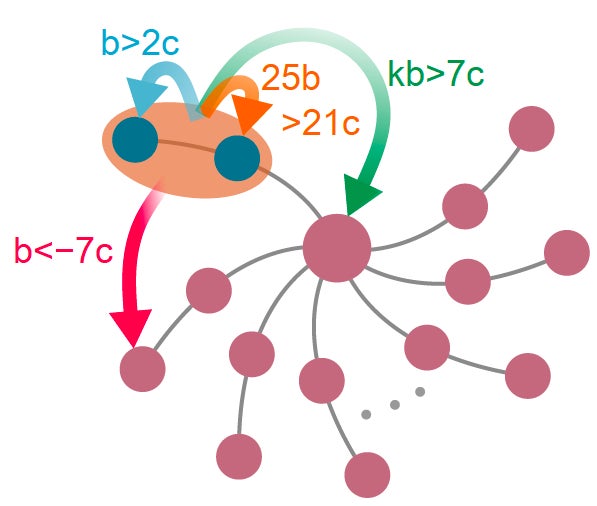
Living beings cooperate in amazing ways, from ants building “living bridges” to amoebae joining together to form giant slugs. How does evolution enable organisms to work together for a greater good? To investigate this question, we create mathematical models of how these cooperative behaviors affect survival and reproduction, and how this in turn affects the spread of genes that influence these behaviors.
Publications:
Allen, B., Khwaja, A.R., Donahue, J.L., Kelly, T.J., Hyacinthe, S.R., Proulx, J., Lattanzio, C., Dementieva, Y.A. and Sample, C. (2024). Nonlinear social evolution and the emergence of collective action. PNAS Nexus, 3(4), page131.
Allen, B., Lippner, G., Chen, Y.T., Fotouhi, B., Momeni, N., Yau, S.T. and Nowak, M.A. (2017). Evolutionary dynamics on any population structure. Nature, 544(7649), 227-230.
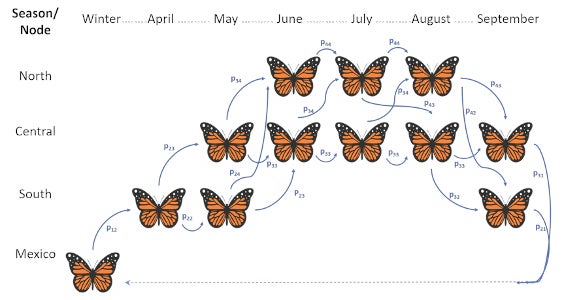
Birds, butterflies, whales, and many other animals embark on epic migrations each year. Understanding their migratory patterns can help us ensure the continued survival of these species in the face of environmental change. We use mathematical modeling to answer questions like which habitats are most important for conservation, and how migration affects the spread of new mutations.
Publications:
Sample, C., Bieri, J.A., Allen, B., Dementieva, Y., Carson, A., Higgins, C., Piatt, S., Qiu, S., Stafford, S., Mattsson, B.J. and Semmens, D.J. (2019). Quantifying source and sink habitats and pathways in spatially structured populations: A generalized modelling approach. Ecological Modelling, 407, 108715.
Sample, C., Bieri, J.A., Allen, B., Dementieva, Y., Carson, A., Higgins, C., Piatt, S., Qiu, S., Stafford, S., Mattsson, B.J. and Semmens, D.J. (2020). Quantifying the contribution of habitats and pathways to a spatially structured population facing environmental change. American Naturalist, 196(2), pp.157-168.
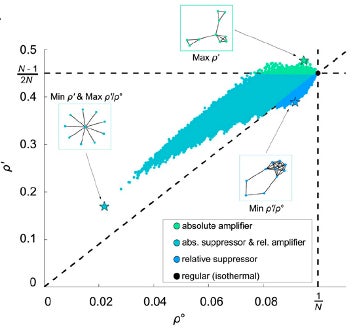
Evolution does not always proceed at the same pace. A variety of factors can speed evolution up or slow it down. One key factor is the population structure: the networks of connection and replacement among individuals. Using mathematical analysis and computer algorithms, we investigate how these networks promote or inhibit the spread of new mutations, which in turn affects how fast a population evolves.
Publications:
Belanger, E., Seard, A., Hoang, A., Tran, A., Antonio, L.G., Dementieva, Y.A., Sample, C. and Allen, B., 2023. How asymmetric mating patterns affect the rate of neutral genetic substitution. Frontiers in Ecology and Evolution, 11, p.1017369.
Allen, B., Sample, C., Steinhagen, P., Shapiro, J., King, M., Hedspeth, T., & Goncalves, M. (2021). Fixation probabilities in graph-structured populations under weak selection. PLOS Computational Biology, 17(2), e1008695.
Allen, B., Sample, C., Jencks, R., Withers, J., Steinhagen, P., Brizuela, L., Kolodny, J., Parke, D., Lippner, G. and Dementieva, Y.A. (2020). Transient amplifiers of selection and reducers of fixation for death-Birth updating on graphs. PLOS Computational Biology, 16(1), p.e1007529.

Ben Allen is an Associate Professor of Mathematics at Emmanuel College. Their research uses mathematical modeling to illuminate general principles of evolution. Specific research questions include how cooperation evolves, how spatial and network structure shape evolution, and how fast evolution proceeds. Their modeling approach ranges from concrete models of specific populations to abstract frameworks for proving general theorems. Prior to Emmanuel College, they received a PhD in Mathematics from Boston University, and worked as a Research Scientist at Harvard University’s Program in Evolutionary Dynamics. When not working, you might find them playing keyboard in a band with Emmanuel faculty and staff.

Dr. Yulia Dementieva is a Professor of Mathematics and a Coordinator of Biostatistics program at Emmanuel College. She received her PhD in Mathematics in 2001 from Emory University, Atlanta, GA. Throughout the years, her research interests have been in the areas of discrete mathematics, statistical genetics, applications of statistics in biomedical research, and evolutionary dynamics. Currently, as a part of Emmanuel mathematical biology research group, she is interested in modeling the migration patterns of Northern Pacific humpback whales. Dr. Dementieva teaches a variety of mathematics courses and finding everyday joy in sharing mathematical methods, patterns, and ideas with students.

Dr. Christine Sample is an Associate Professor of Mathematics at Emmanuel College, where she combines her interest in the sciences with her expertise in mathematical modeling. After earning her undergraduate degree in math and computer science, she worked as a web programmer before pursuing a PhD in applied mathematics, focusing on applications in electrochemistry and biology. Christine values collaborative, interdisciplinary research, from her postdoctoral work in a developmental biology lab to partnering with a team to model migratory species. She especially enjoys working alongside Dr. Allen, Dr. Dementieva, and Emmanuel students on problems in ecology and evolutionary biology. Outside of academia, she loves yoga and the outdoors.

Jacob W. Proulx is currently a junior at Emmanuel College, studying mathematics, statistics, and data analytics. After graduation, Proulx hopes to become a Data Analyst or Research Analyst, helping companies and organizations make informed, data-driven decisions. Proulx thoroughly enjoys participating in mathematical biology research on campus, as he has always been fascinated by how numbers can illustrate and explain natural phenomena. Beyond mathematics, Proulx is also interested in computer science and social justice issues, potentially addressing injustices through analytical means during his career. Outside of academics, Proulx enjoys exploring Boston, watching drag performances, and streaming educational YouTube videos.

Lydia G. Vann is currently a junior at Emmanuel College majoring in mathematics and minoring in math education. Lydia has had a lifelong passion for math, and has always been interested in using math to discover and explain real-world patterns and connections. Lydia has thoroughly enjoyed having the opportunity to model the migration patterns of Northern Pacific humpback whales, as this ties together her love of math as well as her background from California. Outside of her work with the Emmanuel mathematical biology research group, Lydia enjoys helping others discover the beauty of math through her work as an OURFA²M² conference organizer, and a virtual mathematics tutor. In her future, Lydia hopes to pursue graduate school and continue research and teaching. Outside of academics, Lydia loves to dance and listen to music.
Latest News in Research


