Posted On
Topics
STEM
Share


As demand for data scientists surges nationwide, Emmanuel this fall introduced a new Data Science major designed to prepare students for a data-driven economy.
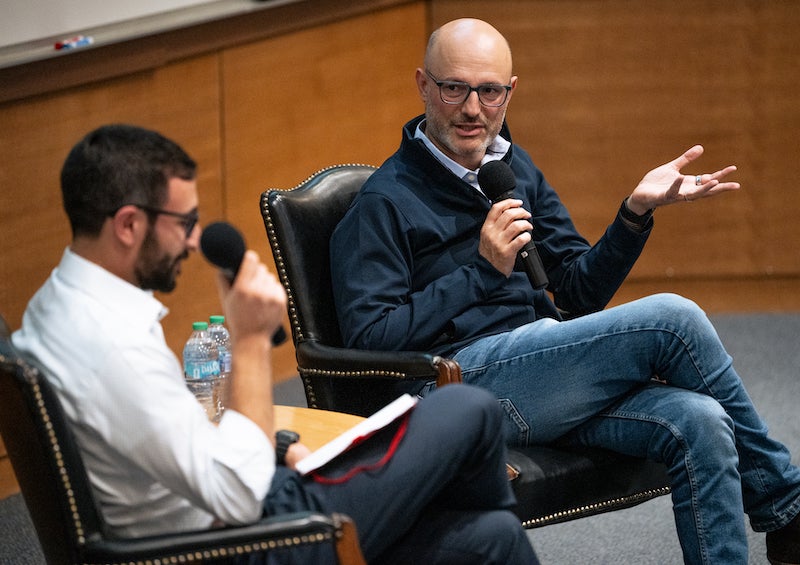
To mark the program’s launch, Tareef Kawaf, CEO of the Boston-based firm Posit, joined a fireside chat hosted by Associate Professor of Biology Vincent Cannataro, and offered students, faculty, staff, and the community a window into the rapidly evolving field, highlighting the skills needed to navigate it with curiosity, rigor, and ethical awareness.
Kawaf, whose career spans startups, leadership roles, and a deep engagement with open-source tools, drew on both his computer science background and his liberal arts education as he shared insights with the audience. “Computer science teaches you how to think in ways that are underappreciated,” he said. “Systems thinking, process engineering, abstraction, understanding networks—these principles help me evaluate organizational structures, anticipate bottlenecks, and solve complex problems. It’s a skill set that extends far beyond writing code.”
Curiosity and Lifelong Learning
The conversation emphasized the importance of intellectual curiosity and continuous learning. “Data science is about curiosity, learning, and problem-solving across domains,” Kawaf said. “The only people who succeed are always learning.” He encouraged students to tackle challenges incrementally, breaking complex problems into manageable pieces—whether in coding, data analysis, or decision-making.
Yet, he acknowledged the modern obstacles to deep thinking. “Distraction is a pandemic,” Kawaf said, referencing the pervasive influence of social media platforms. He urged students to cultivate focus, minimize interruptions, and develop the ability to sit with difficult problems for extended periods—a skill he considers increasingly rare but essential for success.
The new Data Science major at Emmanuel is designed with these principles in mind. Students gain technical skills in statistics, computer science, and analytics, while developing critical thinking, ethical judgment, and communication skills to interpret and convey insights effectively. Careers in data analysis, data engineering, and machine learning are projected to grow by 39% in Massachusetts over the next decade, with salaries ranging from $60,000 for entry-level analysts to $200,000 for specialized engineers, according to the Bureau of Labor Statistics.
“This new major is an example of Emmanuel adapting to new fields and technologies, while retaining the grounding in ethical principles and social justice that are the hallmarks of an Emmanuel education. I’m very excited to start working with students on how to make principled decisions from real-world data,” said Professor of Mathematics Benjamin Allen, who spearheaded the new major.
As students consider their futures in this dynamic field, Kawaf’s guidance echoed throughout the room: remain curious, communicate clearly, act ethically, and focus relentlessly. The path from insight to impact, he suggested, requires not only technical skill but also character—a lesson that Emmanuel’s new major aims to instill.