Posted On
Topics
Events
Politics
Share


The role of the United States on the world stage during a second Trump administration was the central topic of a panel discussion between three career international relations professionals at Emmanuel College on Dec. 11th.
Hosted by the Institute of Eastern Mediterranean Studies (IEMS) at Emmanuel College, the panel featured retired U.S. Ambassadors Jeffrey DeLaurentis and Mark Storella and former Montenegrin Ambassador Vesko Garčević.
While a wide range of opinions were aired during the 90-minute discussion, there was a shared expectation the next Trump administration would be unpredictable, unconventional, and unlikely to continue the brand of U.S. foreign policy that has mostly prevailed since World War II.
“If the United States steps back from a leadership role, the question is ‘who fills that role?” said DeLaurentis.

DeLaurentis was with the U.S Foreign Service for 28 years, and served as a multilateral diplomat at the United Nations in a variety of roles. He was also the first Chargé d’Affaires at the U.S. Embassy in Havana, following the re-establishment of diplomatic relations with Cuba.
Storella said that the international order established in the wake of World War II has been in decline since the end of the Cold War, but expressed concern that the new administration’s disdain for multilateral organizations could hamper progress on issues that require collective action, such a human rights, pandemic preparation, and security.
“That’s the danger we’re facing with the withdrawal of the United States from this international system,” said Storella.
A United States Foreign Service Officer for more than three decades, Storella served as Ambassador to Zambia. He was also Deputy Assistant Secretary of State for Population, Refugees, and Migration, and Dean of the Leadership and Management School of the Foreign Service Institute.
The panel was unofficially moderated by Garčević, a former Montenegrin Ambassador to Austria, Belgium, Luxembourg and the Netherlands. Among other roles, he was also ambassador of Montenegro to NATO and the Organization for Security and Cooperation in Europe (OSCE).
Garčević divided President Elect Trump’s camp into three schools of thought: those committed to maintaining U.S. leadership in world affairs, isolationists who would seek the opposite, and “prioritizers,” who would seek to downsize commitments in Europe and the Middle East, while possibly taking a hard line with China. He thought the third group would likely take the lead with the upcoming administration.
Garčević also offered some helpful advice for the Political Science and International Studies majors in attendance.
“Diplomacy is often more about crisis management rather than crisis resolution,” said Garčević. “Place hope in diplomacy, be realistic in expectations.”
Among the students attending the event was Ben Paluk ’25, a Political Science and Economics major.
“It was great to hear from experts in the field that have dedicated their lives to discussing rather than causing conflict,” said Paluk. “I am happy to be able to attend these panels at my own college, where students and faculty listen to understand and not simply respond."

The panel was convened by IEMS founder and Emmanuel Associate Professor of Political Science Dr. Petros Vamvakas. He termed it a great learning opportunity for students to view foreign policy as part of a continuum of issues, many of which are close to home.
“I think when we talk about international relations, we tend to view it as Americans, with others being foreign, when in fact it is very proximate and we are part of it,” said Dr. Vamvakas.
Emmanuel College offers an interdisciplinary International Relations major and also a Political Science major with a concentration in International Relations and Comparative Politics.
Dr. Vamvakas is involved with both, and highlighted real-world experience as an important component of the programs. He journeyed to the United Nations headquarters with students last spring and arranged meetings for the students with delegations from two countries. He also leads regular travel courses to Crete and Greece.
“We try to constantly combine the classroom with the practical aspects of the international,” said Dr. Vamvakas.
Formally established in 2018, the IEMS promotes and supports the study of the Eastern Mediterranean and neighboring regions by building on the liberal arts mission of Emmanuel College and leveraging the academic and innovative power of Boston.
The institute’s work and reputation has expanded well past Boston, with Dr. Vamvakas invited earlier this year to serve as an expert panelist for a conference at Oxford.
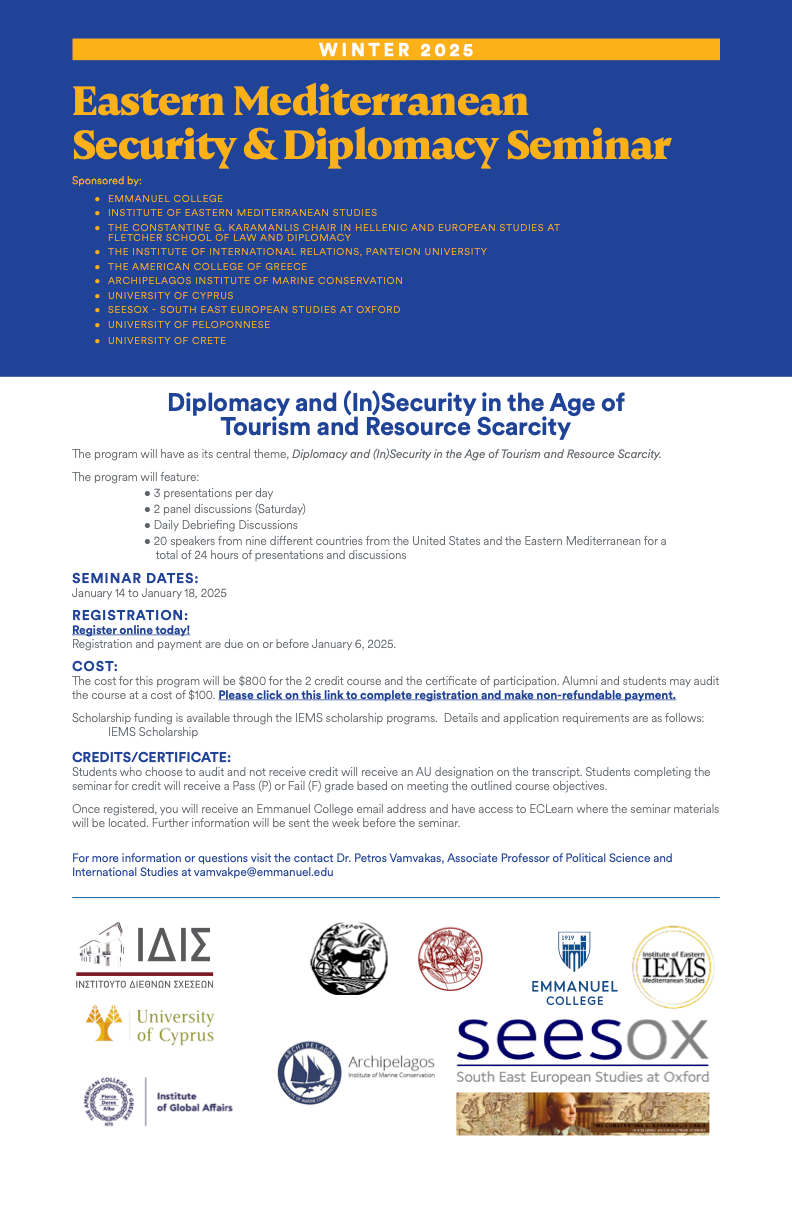
The IEMS plans to kick off 2025 with its fifth annual virtual one-week seminar: Diplomacy and (In)Security in the Age of Tourism and Resource Scarcity. Open to all who wish to register, the seminar will bring together experts from around the world in a collaboration of institutes and universities from the US, Europe and the UK.
Click here to learn more about the Diplomacy and (In)Security in the Age of Tourism and Resource Scarcity seminar.