In this globalized, multicultural world, knowledge of and appreciation for other religions and cultures is essential.
From the Bible to the Buddha, from metaphysics to ethics, from history to today’s news, the study of religion is both fascinating and complex. Emmanuel's courses cover historical and present-day issues such as the role doctrine plays in shaping the identities of populations around the world, religious conflict and controversy, the interaction between science and religion, the role of women in religious communities and in society at large, and the diversification and transformation (or not) of religious traditions in contemporary society. Our emphasis on experiential learning, service, and social justice will help prepare you to be a caring and astute global citizen.
A First-Class Experience
Get to know the people and programs that will define your academic journey.
Johnston writes article "St. Augustine, just war and the plight of civilians in Israel and Gaza"
This work speaks on the situation in Israel and Palestine and how just war theory plays into the conflict that goes on in the region.
Meet the Faculty
Our distinguished faculty publish, exhibit and research. Present, compose and chair. Inspire and collaborate.
The Curriculum
View the 2025-2026 Academic Catalog to find course titles, numbers and descriptions.
Requirements for B.A. in Theology and Religious Studies
Two introductory courses:
- THRS1111 Exploring the Bible (RICT) AND EITHER
- THRS1103 Exploring Catholic Theology (RICT) OR
- THRS1115 Jesus and Christian Ethics (RICT)
At least three courses from the following:
- THRS2101 What is Religion? (RI)
- THRS2102 In the Beginning: Adam to Moses (RICT)
- THRS2108 Religion and the Environment: Ethical Explorations
- THRS2111 Love and Justice (RICT) (SJ)
- THRS2114 The Prophets: Power, Politics and Principles (RICT) (SJ)
- THRS2116 Science and Religion (RICT)
- THRS2135 World Religions (RI) (DM)
- THRS2201 War, Peace and Religions (RI) (SJ)
- THRS2205 The Gospels: Portraits of Jesus (RICT)
- THRS2207 Controversy in the Church: Reading the Signs of the Times (RICT) (SJ)
- THRS2217 Women in the World Religions
- THRS2219 Women in Christian Traditions (RICT) (DM)
- THRS2221 Progressive Christianity (RICT) (SJ)
- THRS2222 Social Justice and Global Health (RICT) (SJ)
- THRS2223 The First Christians (RICT)
At least one course from the following:
- THRS2105 Judaism (RI) (DM)
- THRS2202 Hinduism (RI) (DM)
- THRS2211 Islam (RI)
- THRS2212 Buddhism: Beliefs and Practices (DM)
Three other 2000- or 3000-level courses, at least two of which must be 3000-level, or 4178, Directed Study.
Also required:
- THRS4182 Directed Research
Students may include an approved internship as one of their ten courses.
View the 2025-2026 Academic Catalog to find course titles, numbers and descriptions.
Requirements for Minor in Theology & Religious Studies
The Minor in Theology & Religious Studies provides a convenient curriculum for students who would like to explore their religious questions beyond two courses, but who do not have room in their schedule for either a full-time major or a double major. The Minor consists of five courses chosen in consultation with a departmental advisor, at least one of which must be at the 3000-level, and no more than two at the 1000-level.
Upon completion of the major in Theology and Religious Studies, students will be able to:
- Demonstrate an understanding of religions as historically rooted and constantly developing traditions.
- Apply theological claims to moral reasoning and practice.
- Competently analyze primary texts from at least one major religious tradition.
- Analyze the interaction of religion with society, politics, the arts and culture.
- Compare and contrast popular misconceptions of religion with scholarly knowledge of religion.
- Evaluate theological claims for internal consistency, coherence with human experience and social expression.
- Demonstrate the skills to write cogently, reason critically, present professionally and discuss competently.
- Synthesize acquired knowledge into an original work of critical scholarship.
What can I do with a degree in theology and religious studies?
A degree in theology and religious studies can prepare you for a wide variety of careers, depending on your interests and skills. Here are some examples:
- Religious leader: You could become a minister, priest, rabbi, imam, or other religious leader in a faith community.
- Academic: You could become a professor of theology or religious studies, teaching at the university level.
- Non-profit work: You could work for a non-profit organization that focuses on religious or spiritual issues, such as an interfaith organization, a humanitarian aid group, or a social justice organization.
- Writer or journalist: You could use your knowledge of religion and spirituality to write books, articles, or other media, or to work as a journalist covering religion-related news.
- Counselor or therapist: You could become a counselor or therapist specializing in religious or spiritual issues, working with individuals, families, or groups.
- Chaplain: You could work as a chaplain in a hospital, prison, military setting, or other institution, providing spiritual care and support to patients, inmates, or other individuals.
- Government or diplomatic work: You could work for a government agency or in a diplomatic role, using your knowledge of religion and culture to inform your work.
- Social worker: You could become a social worker with a focus on working with individuals or communities with spiritual or religious needs.
- Museum or cultural institution work: You could work in a museum or cultural institution, helping to curate exhibits or develop programming related to religion and spirituality.
- Entrepreneur: You could start your own business, such as a bookstore, gift shop, or online resource center, specializing in religious or spiritual materials and resources.
Students who major in theology and religious studies develop a variety of skills that can be valuable in many different professions. Some of the skills that theology majors may obtain include:
- Critical thinking: Theology majors learn to analyze complex texts and ideas, and to think deeply about the meaning and significance of religious traditions.
- Research skills: Students in theology and religious studies programs learn to conduct research, evaluate sources, and write clearly and persuasively.
- Cultural competence: Students in theology and religious studies programs learn about diverse religious traditions and practices, which can help them to develop cultural competence and respect for diverse perspectives.
- Interpersonal skills: Theology majors often have opportunities to engage with people from a variety of backgrounds, which can help them to develop strong interpersonal skills.
- Ethics and morality: Many theology programs focus on questions of ethics and morality, which can help students to develop strong ethical principles and a commitment to social justice.
These skills can be valuable in many different professions, including education, nonprofit organizations, social work, journalism, and government.
Where Essential Values and Skills Meet the Real World
Along with areas of knowledge and major requirements, you will cultivate essential values in the classroom and complete two courses in each area:
- Social Justice (SJ): Develop knowledge, skills, values and motivation to participate beneficially in activities of personal and public concern.
- Diversity & Multiculturalism (DM): Understand the complexity of identity the historical truths of different cultural perspectives to address bias and examine contemporary social issues.
One hundred percent of Emmanuel students complete an internship as part of the core curriculum. In a city as dynamic as Boston, your options are bound only by the limits of your curiosity.
Boston's religious traditions are as diverse as its population, and the city offers many opportunities to explore world religions from Christianity to Islam to Buddhism. Students also intern at Boston's many nonprofits, within state or city government offices, in the legal or education sectors and more.
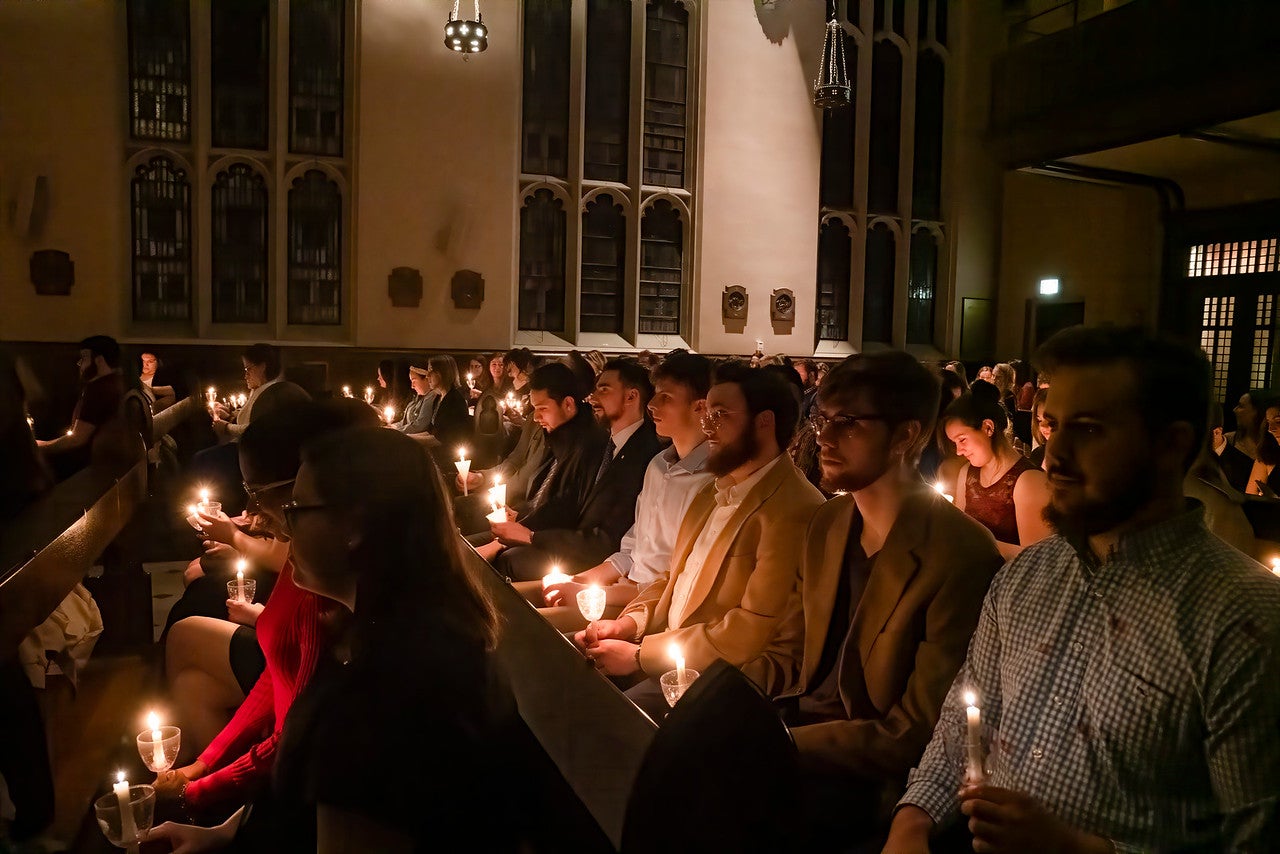
In all majors, the Capstone Experience involves completing a significant piece of work that requires the integration and application of learning from multiple courses.
Scripture and ethics. Religion and power. The culminating experience for Theology & Religious Studies majors is a Directed Research and Seminar course, during which you will work closely with a faculty advisor to conduct independent research and to write a major paper that demonstrates both the ability to examine a topic in depth and to integrate and synthesize two or more areas in Theology & Religious Studies.
Humanities & Social Sciences Spotlight
See more news and stories related to the School of Humanities & Social Sciences